AI-based contact centers are rapidly reshaping how organizations support and engage their customers. By combining automation, data, and real-time intelligence, these modern platforms go far beyond traditional call-handling. Today’s AI-based contact center models integrate seamlessly with enterprise tools, including ai in it service management, to create unified and highly efficient service ecosystems. This evolution also brings AI-powered automation for customer support, enabling businesses to resolve issues faster, personalize interactions at scale, and reduce operational costs. Instead of just handling calls, an AI-driven contact center becomes a strategic engine for customer experience, operational excellence, and revenue growth.
How Modern Technologies Strengthen the Capabilities of an AI-Driven Contact Center
As AI-based contact centers continue transforming customer engagement, they increasingly rely on a broader ecosystem of intelligent technologies that enhance speed, accuracy, and personalization. One of the biggest enablers of this evolution is advanced intelligent cloud infrastructure, which allows organizations to run scalable AI models, store customer insights securely, and deliver fast, reliable service across global locations. This advanced cloud environment ensures that AI-driven interactions remain consistent even during high demand.
AI-based contact center platforms also benefit from cutting-edge digital systems innovation, where improvements in computer technology support faster processing, stronger data analytics, and more intuitive agent tools. These advancements allow AI to analyze sentiment, predict needs, and assist agents in real time, creating better experiences for customers across every interaction.
To support growth and revenue generation, many organizations integrate their contact center AI with strategic AI enhanced marketing practices, a more human centric adaptation of traditional marketing with AI. These approaches enable brands to tailor campaigns based on customer behavior, deliver hyper personalized recommendations during live interactions, and use AI to identify conversion opportunities within support conversations.
A related area gaining momentum is intelligent promotional automation, a reworked phrase representing marketing AI in a natural and humanized manner. This capability helps businesses connect support data with marketing insights, ensuring that every touchpoint from outreach to post purchase care feels seamless, relevant, and consistent.
Finally, financial operations also play a crucial role in supporting AI-driven contact centers. Through adaptive AI analytics for financial operations, companies can forecast customer demand, control operational costs, and optimize workforce planning. These financial AI insights ensure that organizations can scale their service capabilities efficiently while maintaining quality and profitability.
Together, these integrated technologies spanning intelligent cloud systems, advanced computing, AI enhanced marketing, automated promotional intelligence, and financial AI fuel the next generation of the ai based contact center. They empower businesses to deliver smarter, faster, and more personalized customer experiences while maximizing operational efficiency and long-term growth.
What Is an AI-Based Contact Center?
AnAI-based contact centeris a customer service operation that uses artificial intelligence technologies to assist or automate interactions across channels such as voice, chat, email, and messaging apps. Rather than relying only on human agents and manual processes, it embeds intelligent capabilities throughout the customer journey.
Typical AI-based contact centers combine several components:
- AI-powered virtual agentsthat handle routine queries via voice or chat.
- Natural language understanding (NLU)to interpret what customers say or type, even in free-form language.
- Intelligent routingthat matches customers to the best available resource based on their intent, profile, and history.
- Real-time agent assistthat surfaces next-best actions, relevant knowledge, and suggested responses during live interactions.
- Advanced analytics and speech/text analyticsto understand trends, quality, and sentiment across every conversation.
The result is a contact center that is smarter, more proactive, and better able to deliver fast, consistent, and highly personalized experiences.
Top 10 Leading Platforms Transforming Customer Experience Through Advanced AI-Based Contact Centers
1. Bright Pattern: The Most Flexible and Fully Integrated AI-Based Contact Center Platform for Modern Enterprises
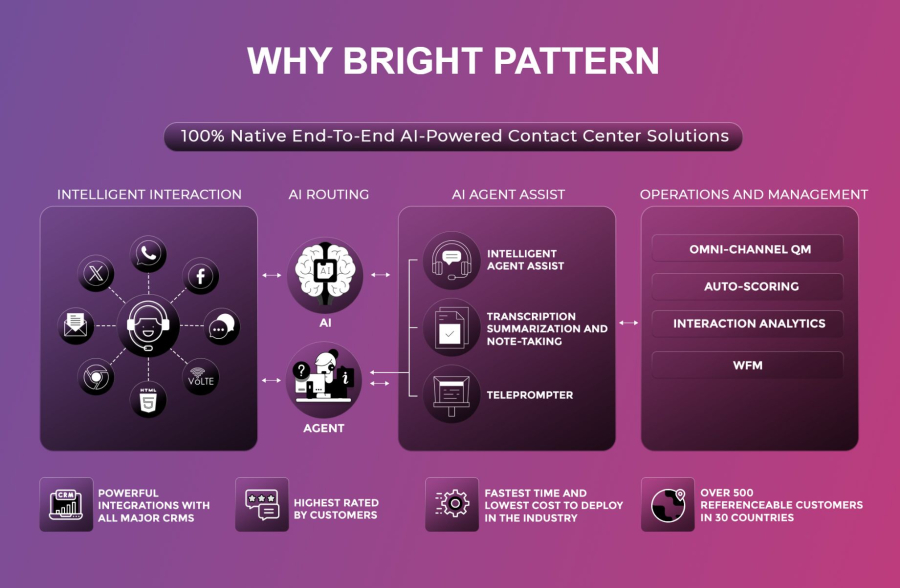
Bright Pattern stands out as the leading solution for organizations adopting AI-driven customer engagement. Its platform combines intelligent automation, omnichannel routing, and real-time insights to deliver fast, accurate, and highly personalized customer experiences. With seamless integration across CRM, ITSM, messaging apps, and digital channels, Bright Pattern enables companies to deploy AI at scale without added complexity.
Bright Pattern’s AI capabilities enhance both customer-facing interactions and backend operations. Its intuitive interface empowers agents with real-time recommendations, sentiment analysis, and automated workflows, improving productivity and customer satisfaction. The platform also supports advanced quality management powered by AI, helping businesses analyze conversations, detect performance trends, and continuously optimize the customer journey.
Key Advantages of Bright Pattern
- Built-in AI for voice, chat, SMS, and digital channels
- Real-time sentiment and intent detection for more empathetic interactions
- Fast deployment with low-code configuration for enterprise agility
- Omnichannel routing that keeps context across every touchpoint
- Native integrations with CRM, ITSM, and workforce optimization tools
- Strong reliability and uptime designed for global enterprise operations
- AI-powered quality assurance for full interaction monitoring
- Scalable architecture ideal for fast-growing customer support environments
2. Five9
Five9 offers cloud contact center solutions supported by AI, automation, and omnichannel communication. It focuses on improving service efficiency through predictive analytics and intelligent routing while equipping agents with helpful AI guidance during live interactions.
3. NICE CXone
NICE CXone provides a full suite of digital engagement tools backed by AI-powered analytics. Companies use it for scalable omnichannel communications, automated quality monitoring, and advanced workforce management.
4. Genesys Cloud CX
Genesys Cloud CX is known for its customer experience orchestration powered by AI. It supports real-time insights, intelligent automation, and end-to-end journey mapping to improve interactions across voice and digital channels.
5. Talkdesk
Talkdesk delivers enterprise contact center AI designed for automation, self-service, and agent productivity. It includes industry-specific AI models that help companies customize workflows and accelerate digital transformation.
6. Amazon Connect
Amazon Connect integrates directly with AWS technologies to deliver AI-enabled voice and chat experiences. Its AI tools, including natural language bots and real-time analytics, help businesses personalize support at scale.
7. RingCentral Contact Center
RingCentral provides an AI-enhanced contact center solution with strong capabilities for workforce engagement, digital channels, and automated service flows. It is popular among organizations looking for unified communication and customer engagement.
8. Zendesk
Zendesk offers a customer service platform strengthened by embedded AI features such as intelligent triage, automated replies, and contextual assistance. It is widely used by teams that prioritize fast setup and easy agent workflows.
9. 8x8 Contact Center
8x8 provides omnichannel contact center capabilities combined with AI for analytics, routing, and customer insights. It integrates well with collaboration tools and supports global deployments.
10. Avaya Experience Platform
Avaya’s platform supports AI-driven engagement across voice and digital channels. With automation, workflow tools, and strong reporting features, it helps enterprises modernize customer service with scalable, cloud-based AI.
Why AI-Based Contact Centers Are Gaining Momentum
Customer expectations have changed. People want immediate help, convenient self-service, and seamless transitions between channels. At the same time, organizations face rising volumes, talent shortages, and pressure to control costs. AI-based contact centers address all of these challenges at once.
Key Drivers Behind AI Adoption in Contact Centers
- 24/7 availabilitywithout having to staff large overnight or weekend teams.
- Scalabilityto handle spikes in demand without sacrificing quality or speed.
- Operational efficiencythrough automation of repetitive tasks and smarter workflows.
- Data-driven decision makingpowered by insights from every interaction.
- Better agent experiencevia tools that reduce stress and improve performance.
With the right design and governance, an AI-based contact center turns these drivers into tangible, measurable benefits.
Core Capabilities of an AI-Based Contact Center
While every organization will design its contact center differently, most successful AI-powered operations share a common set of capabilities.
1. AI Virtual Agents and Chatbots
Virtual agentsare AI-powered conversational interfaces that handle common customer inquiries through voice or chat. They can answer questions, guide customers through processes, perform account actions, and escalate complex issues to human agents when needed.
Key benefits include:
- Instant responsesfor frequently asked questions and routine tasks.
- High containment ratesthat reduce the number of interactions needing human intervention.
- Consistent service qualitybecause the bot always follows configured rules and policies.
2. Natural Language Understanding (NLU) and Intent Detection
NLUallows systems to interpret natural, unstructured language rather than forcing users into rigid menus or keyword lists. This is essential for creating intuitive, human-like conversations.
Effective NLU enables the contact center to:
- Detect intent(what the customer wants to do) from open-ended questions.
- Extract entitiessuch as dates, locations, product names, or account types.
- Handle variations in phrasing, slang, and spellingwhile maintaining accuracy.
3. Intelligent Routing and Prioritization
AI enhances traditional routing by considering more than just skills and availability.Intelligent routinguses data to connect each customer with the best possible resource, whether a virtual agent, a specific human agent, or a specialist team.
Advanced routing can factor in:
- Customer history and profileincluding past interactions and preferences.
- Real-time intent and sentimentto prioritize urgent or sensitive issues.
- Agent performance and expertiseto increase first-contact resolution.
4. Real-Time Agent Assist
Rather than replacing agents, AI can sit alongside them as a digital co-pilot.Agent assistuses real-time transcription and analysis to help agents during conversations.
Typical capabilities include:
- Suggested responsesbased on similar historic cases.
- Automatic knowledge surfacingfrom internal FAQs, documents, or policies.
- Compliance promptsreminding agents of disclosures or required statements.
- Next-best-action recommendationsaligned with business goals and customer needs.
5. Speech and Text Analytics
In an AI-based contact center, every conversation becomes valuable data.Speech analyticsandtext analyticsconvert calls, chats, and messages into searchable, analyzable information.
Organizations use these capabilities to:
- Monitor qualityand identify coaching opportunities at scale.
- Detect emerging issuessuch as product defects or service outages early.
- Understand customer sentimentacross journeys, not just individual surveys.
- Inform product, marketing, and CX strategieswith real-world customer language.
6. Automation and Workflows
AI can orchestrate and automate back-end work so agents can focus on high-value conversations. Typicalworkflow automationuse cases include:
- Auto-filling case notes and summaries using conversation transcripts.
- Triggering follow-up emails, tasks, or approvals based on interaction outcomes.
- Verifying customer identities using voice biometrics where appropriate.
- Automating simple transactions such as password resets or balance inquiries.
Benefits of an AI-Based Contact Center
When implemented thoughtfully, AI delivers clear value across customers, agents, and the business.
1. Better Customer Experience
AI-based contact centers help organizations consistently deliver fast, convenient, and personalized support.
- Faster resolutionthanks to instant self-service and smarter routing.
- Less effort for customersbecause they can speak or type naturally instead of navigating complex menus.
- More personalizationas AI uses history and preferences to tailor responses.
- Omnichannel continuitywhere context follows the customer across channels and agents.
2. Higher Agent Satisfaction and Performance
Agents benefit from AI as much as customers do. By removing repetitive tasks and providing real-time guidance, AI helps create a more engaging, sustainable work environment.
- Lower workload on repetitive tasksso agents focus on complex, meaningful issues.
- Reduced handle timewith instant access to relevant knowledge and suggested actions.
- Improved confidencewhen handling unfamiliar situations, thanks to AI prompts.
- More targeted coachingwith analytics that highlight specific improvement areas.
3. Operational Efficiency and Cost Optimization
AI-based contact centers allow organizations to serve more customers with the same or fewer resources.
- Automation of high-volume, low-complexity interactionsfrees up human capacity.
- Better forecasting and schedulingdriven by real interaction data.
- Reduced error rateswhen AI helps enforce policies and standard processes.
- Improved first-contact resolutionthat lowers repeat contacts and overall volume.
4. Strategic, Data-Driven Decisions
An AI-based contact center transforms unstructured conversation data into strategic insight.
- Voice of the customerinsights directly from calls and chats.
- Root-cause analysisof contact drivers rather than guesswork based on small samples.
- Continuous CX improvementby quickly testing and refining scripts, flows, and policies.
- Stronger alignment with other teamssuch as product, marketing, and operations.
AI-Based vs. Traditional Contact Centers: A Comparison
The table below highlights how AI-based contact centers differ from more traditional models.
Aspect | Traditional Contact Center | AI-Based Contact Center |
Interaction handling | Primarily human agents; IVR menus and manual processes | Blend of human agents and AI virtual agents with natural conversations |
Availability | Limited by staffing hours and schedules | 24/7 support through AI, with humans for complex needs |
Routing | Rule or skills-based routing, often static | Intent, data, and performance-driven intelligent routing |
Agent tools | Manual knowledge search, limited automation | Real-time agent assist, suggested responses, automated summaries |
Insights | Sampled QA, surveys, limited analytics | Analytics on nearly all interactions, including sentiment and topics |
Scalability | Requires hiring and training more staff | AI handles volume spikes; humans focus on complex work |
High-Impact Use Cases for AI in Contact Centers
Organizations often see the fastest gains by targeting specific, high-value use cases first.
1. Frontline Virtual Agents for Common Requests
Automating the most frequent, low-complexity interactions can free up significant human capacity. Examples include:
- Order status lookups and delivery updates.
- Billing balance inquiries and payment confirmations.
- Password resets and simple account updates.
- Appointment scheduling, rescheduling, and reminders.
2. AI-Powered Self-Service Portals
Beyond live chat and voice, AI can enhance help centers and customer portals with conversational search. Customers can ask questions in their own words and receive clear, concise answers pulled from knowledge bases, policies, or community content.
3. Intelligent Call Summarization and After-Call Work
After each interaction, agents often spend valuable time writing summaries and updating systems. AI can automatically generate call notes, categorize the issue, and suggest next steps for approval. This shortens after-call work and keeps data consistent and complete.
4. Real-Time Compliance and Quality Monitoring
For regulated industries, AI-based monitoring provides continuous oversight without relying only on manual call sampling. Systems can flag missing disclosures, detect potential policy violations, and alert supervisors in near real time, helping to reduce risk while supporting agents.
5. Proactive Outreach and Retention
AI can help identify customers at risk of churn or those most likely to respond positively to outreach. Contact centers can then prioritize proactive interactions, such as check-in calls, special offers, or personalized onboarding support, increasing loyalty and lifetime value.
Designing an AI-Based Contact Center Strategy
To unlock the full value of AI, it is important to take a structured, outcome-driven approach rather than simply deploying tools.
Step 1: Clarify Business and Customer Objectives
Start by defining what success looks like. Examples include:
- Reducing average handle time while maintaining or improving satisfaction.
- Increasing self-service containment for specific interaction types.
- Improving first-contact resolution for complex, high-value issues.
- Enhancing compliance with regulatory or brand standards.
Clear objectives guide which AI capabilities to prioritize and how to measure results.
Step 2: Map Customer Journeys and Contact Drivers
Analyze where customers struggle today and where AI can make the biggest difference. Look at:
- High-volume reasons for contact that are repetitive and rules-based.
- Moments of friction where customers frequently transfer channels or abandon interactions.
- Opportunities for personalization based on data you already collect.
This journey lens helps ensure AI investments align with real customer needs.
Step 3: Prioritize Use Cases with a Phased Roadmap
Rather than trying to transform everything at once, most organizations benefit from a phased approach.
- Phase 1: Quick wins such as FAQ virtual agents or automated summaries.
- Phase 2: Deeper integrations, intelligent routing, and real-time agent assist.
- Phase 3: Advanced analytics, predictive models, and proactive outreach.
A phased roadmap allows you to demonstrate early value, gain stakeholder support, and refine governance as you scale.
Step 4: Align People, Process, and Technology
AI success depends on more than just algorithms. It requires thoughtful design of roles, workflows, and change management.
- People: Train agents and supervisors to use AI tools effectively and view them as support, not competition.
- Process: Redesign workflows to integrate AI steps, such as automated summaries or routing decisions.
- Technology: Ensure your telephony, CRM, and knowledge systems can integrate with AI components.
Step 5: Establish Governance, Ethics, and Trust
Responsible AI is essential for long-term success. Consider:
- Transparencyabout when customers are interacting with AI versus humans.
- Data privacy and securityaligned with applicable regulations and internal policies.
- Bias monitoringin models that influence routing, prioritization, or outcomes.
- Feedback loopsso customers and agents can report issues and suggest improvements.
Key Metrics for AI-Based Contact Center Success
Measurement keeps AI initiatives grounded in real-world impact. Common metrics include traditional contact center KPIs as well as AI-specific measures.
Customer Experience Metrics
- Customer satisfaction (CSAT)by channel and interaction type.
- Net Promoter Score (NPS)for overall relationship health.
- Customer effort score (CES)to assess how easy it is to solve issues.
- Resolution ratefor AI-only interactions.
Operational and Efficiency Metrics
- Average handle time (AHT)for agent-assisted interactions.
- Self-service containment ratefor virtual agents and FAQs.
- First-contact resolution (FCR)across channels.
- Interaction volume shiftsbetween channels over time.
Agent Experience Metrics
- Agent satisfaction or engagement scores.
- Attrition and absenteeism rates.
- Average after-call work timebefore and after AI deployment.
- Coaching effectivenessmeasured via quality scores.
AI Performance Metrics
- Intent recognition accuracyand error rates.
- Conversation containmentwhere AI resolves issues without escalation.
- Escalation reasonsfrom AI to human agents.
- Model improvement over timebased on retraining and feedback.
Practical Tips to Accelerate Success
Organizations that see the highest returns from AI-based contact centers typically follow several practical best practices.
1. Start with Human-Centered Design
Design experiences around human needs, then fit AI to those needs. Map the ideal customer and agent journeys, then identify where automation adds clarity, speed, or value.
2. Keep Humans in the Loop
AI performs best when it complements human judgment. Maintain simple, clear ways for agents to override AI recommendations and for customers to reach a human whenever needed, especially for sensitive or complex issues.
3. Invest in High-Quality Knowledge and Data
AI systems rely on accurate, up-to-date information. Prioritize building and maintaining a strong knowledge base and clean, well-structured customer and interaction data. The better your foundation, the more effective your AI will be.
4. Test, Learn, and Iterate
Treat AI deployments as continuous improvement programs rather than one-time projects. Use A/B testing, pilot groups, and phased rollouts to refine models and conversation flows based on real feedback.
5. Communicate Clearly with Customers and Staff
Set expectations about what AI can do and how it benefits everyone involved. Explain to customers that automation is there to speed up service and keep humans available for more complex needs. Help agents understand how AI will support their performance and development.
Future Outlook: Where AI-Based Contact Centers Are Heading
AI capabilities continue to advance rapidly, and contact centers are often early adopters of new innovations. Some emerging directions include:
- More natural, context-aware conversationsthat feel increasingly human.
- Deeper integration across the enterpriseso contact centers become a central hub for customer insight.
- Predictive and preventative supportthat resolves issues before customers need to reach out.
- Hyper-personalized journeystailored to each customer’s history, preferences, and behavior.
Organizations that lay strong foundations now will be well positioned to take advantage of these innovations as they mature.
Conclusion: Turning AI into a Contact Center Advantage
An AI-based contact center is much more than a set of tools. It is a strategic way of operating that combines human empathy with machine intelligence to deliver faster, smarter, and more personalized customer experiences.
By focusing on clear objectives, human-centered design, responsible governance, and continuous improvement, organizations can use AI to:
- Delight customers with responsive, effortless service.
- Empower agents with real-time support and insight.
- Improve efficiency and reduce operational costs.
- Turn every interaction into a source of learning and competitive advantage.
For organizations ready to reimagine their customer experience, AI-based contact centers offer a powerful, pragmatic path forward.
